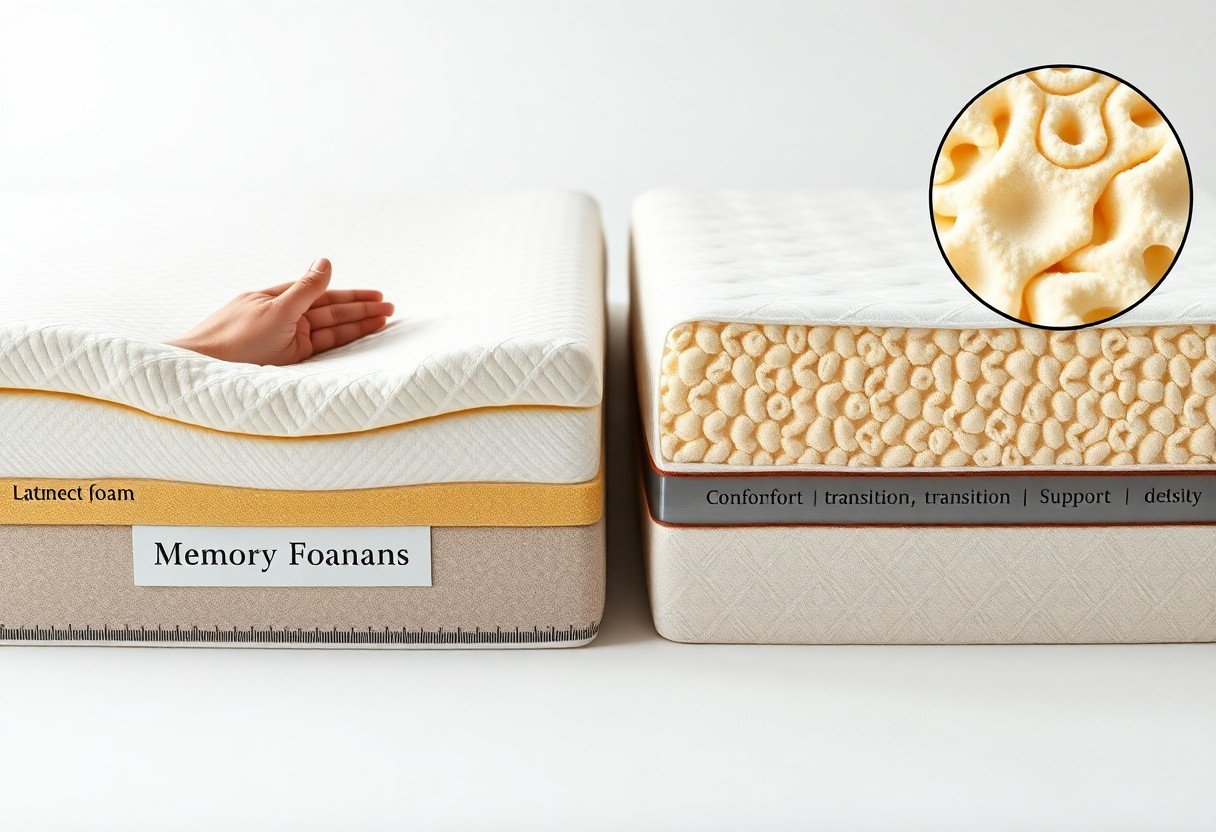
Memory Foam vs Latex Mattresses – Understanding the Key Differences
Just settling into a new mattress can redefine your sleep, and your choice between memory foam and latex shapes everything from pressure relief to motion isolation. You face distinct materials with divergent origins, behaviors, and long-term performance. One molds closely to your body over time, the other responds instantly to movement. Your comfort, temperature regulation, and durability expectations hinge on understanding these core differences from the start.
The Soft Sink of Foam
Memory foam contours closely to your shape by responding to body heat and pressure, creating a sensation of being gently enveloped. Unlike firmer materials, it compresses slowly where weight is applied, particularly around the hips and shoulders, allowing the spine to align in a neutral position. A mid-sized SaaS firm’s remote employees reported improved sleep consistency after switching to memory foam, citing reduced pressure points during long work-from-bed stretches.
Cradling the body
Pressure relief defines the core benefit of memory foam’s deep conforming ability. It molds precisely to the curves of your back, thighs, and neck, distributing weight more evenly than many hybrid or innerspring alternatives. This adaptive layer minimizes concentrated stress on joints, a key reason why side sleepers often favor it. Some users describe the sensation as lying in a molded impression rather than on top of a surface, similar to how dental putty captures every ridge of a tooth.
Manufacturers achieve this effect through viscoelastic polymer structures that soften with warmth. The material remains firm in cooler areas of the bed, providing subtle support while softening under contact points. Early versions from the 1990s often trapped heat, but modern iterations incorporate gel infusions or open-cell designs to mitigate this. Even with improvements, the depth of sink remains greater than latex, sometimes making repositioning feel slightly restricted.
Individuals with chronic pain, especially in the lower back or hips, frequently report relief due to the foam’s ability to eliminate pressure spikes. Clinical sleep studies have observed reduced tossing and turning on high-density memory foam compared to traditional innerspring units. The material’s slow response means movement is absorbed rather than transferred, contributing to a sensation of isolation from the rest of the bed.
The stillness of the bed
Motion isolation is a standout trait of memory foam, making it ideal for couples with differing sleep schedules or restless tendencies. When one person shifts, the energy dissipates locally instead of traveling across the surface. This behavior contrasts sharply with coil-based systems, where movement often ripples through interconnected springs. You can turn or get up without jostling your partner, a feature frequently praised in customer reviews of all-foam models.
The dense cellular structure dampens vibrations much like soundproofing foam absorbs audio waves. There’s no bounce or snap-back, so even sudden movements feel muffled. This stillness enhances sleep continuity, especially for lighter sleepers sharing a bed with a more active partner. Some users liken it to lying on a surface that “swallows” motion rather than reflecting it.
Testing conducted by independent labs shows memory foam reduces motion transfer by up to several times compared to pocketed coils. The absence of responsive pushback means limbs don’t rebound after sinking, which can be comforting for those who dislike the springy feel of latex or hybrids. This damping effect extends beyond partner movement-it also minimizes disturbance from pets or children climbing onto the bed.
Even in shared sleeping environments, the localized response ensures your side remains undisturbed when your partner rolls over at 3 a.m. High-density variants offer the best performance, maintaining structural integrity while absorbing kinetic energy. Some premium models combine memory foam with zoned support layers to enhance both stillness and spinal alignment.
The Response of Natural Rubber
Natural rubber, derived from the sap of the Hevea brasiliensis tree, responds to pressure with a resilience distinct from memory foam. When you lie down, the material compresses slightly but rebounds almost immediately, supporting your body without the delayed response common in foam. This elasticity allows for easier movement during sleep, particularly beneficial if you shift positions frequently. A mid-sized SaaS firm’s employee, for example, reported fewer morning stiffness complaints after switching to a natural latex mattress from a memory foam model.
Pushing back
Pressure from your hips and shoulders meets firm resistance from natural rubber, which distributes weight across a broader surface area. Unlike memory foam that cradles deeply, latex pushes back with consistent support, reducing the sensation of sinking. This responsiveness helps maintain spinal alignment, especially for back and stomach sleepers who require less give. Some users describe the feeling as floating just above the surface, supported but not enveloped.
The speed of the surface
Latex springs into action the moment you shift, adjusting in real time to your body’s movements. There’s no lag between your motion and the mattress’s reaction, a trait particularly useful for couples where one partner’s movements might otherwise disturb the other. The surface regains its shape instantly, avoiding the slow recovery seen in memory foam. This immediate responsiveness contributes to a more dynamic sleep experience, especially for restless sleepers.
Latex’s quick recovery is due to its open-cell structure, which allows air to flow freely and the material to bounce back without energy loss. This structural trait not only enhances comfort but also improves durability over time.
The Heat of the Night
Memory foam conforms closely to your body, creating a snug sleeping surface that can retain heat over time. Your body warmth gets absorbed into the dense material, especially in traditional or older foam formulations. This tendency to trap heat often leads sleepers to feel warmer than desired, particularly during summer months or in hot climates. Some find this sensation comforting, while others may wake up overheated in the early hours. Manufacturers have responded with gel infusions and open-cell structures, aiming to mitigate the issue without sacrificing pressure relief.
Latex, by contrast, naturally allows more airflow through its cell structure, reducing the likelihood of heat buildup. You experience less of that clinging warmth common with memory foam, even in solid natural latex cores. The material’s inherent resilience contributes to a cooler sleep environment, especially in Talalay versions which are processed to enhance breathability. Your body heat dissipates more efficiently, helping maintain a stable microclimate throughout the night.
Sleep temperature plays a larger role in rest quality than many realize, and your choice of mattress material directly influences thermal regulation. While memory foam continues to evolve with cooling technologies, its base chemistry still leans toward heat retention. Latex maintains a consistent advantage in thermal neutrality, supported by its open, porous composition. For those sensitive to warmth, this difference can determine not just comfort, but how often you wake feeling too hot.
Trapping the warmth
Memory foam’s dense, viscoelastic structure is designed to absorb and hold body heat, which enhances its contouring effect. You sink in more deeply when the foam softens under warmth, increasing contact with your skin and prolonging heat retention. This can create a microenvironment where temperature rises steadily, especially if you sleep on your back or side for long stretches. Even with cooling gels or copper infusions, the fundamental behavior of the material remains thermally insulative.
Some newer memory foam models incorporate phase-change materials that absorb excess heat at certain temperatures. You may notice a brief cooling sensation when first lying down, but this effect often diminishes after several hours. The foam’s slow response time means it continues to trap warmth rather than release it quickly. In contrast to more breathable materials, memory foam lacks internal channels for air movement, making passive cooling difficult.
If you tend to sleep hot or share a bed with a partner who does, the cumulative heat retention of memory foam can become disruptive. Two bodies generate more warmth, and the mattress may not dissipate it efficiently. You might find yourself adjusting position frequently or relying on external cooling aids like fans or cooling pads. The material’s design prioritizes pressure relief over thermal regulation, a trade-off worth considering in warmer environments.
Breathable layers
Latex mattresses often feature pincore holes or perforated layers that actively promote air circulation throughout the structure. You benefit from vertical airflow that carries heat away from your body, reducing the chance of overheating. These small channels run from the top to the base of the latex core, allowing warm air to escape and cooler air to enter. Unlike memory foam, which relies on surface-level modifications, latex integrates breathability into its foundational design.
Manufacturers sometimes pair latex with natural cover materials like organic cotton or wool, further enhancing moisture wicking and ventilation. You experience a drier, more temperate sleep surface, especially when wool is used as a quilted layer. Its hygroscopic properties pull moisture away from the skin, helping regulate both temperature and humidity. This combination works continuously, without requiring power or external devices.
Even in layered hybrid designs, latex maintains superior airflow compared to all-foam constructions. You gain the support of coils or springs underneath, while the latex top remains open and responsive to thermal shifts. The result is a balanced sleep climate that adapts to your body’s needs throughout the night. A mid-sized SaaS firm’s employee, for example, reported fewer night awakenings after switching to a latex hybrid, attributing the change to improved temperature control.
Wool used in breathable layers does more than wick moisture; it naturally resists dust mites and mildew, adding functional benefits beyond thermal regulation. You gain a sleep surface that actively manages humidity, which is especially helpful in humid climates or for individuals who perspire at night. These natural fibers complement latex’s open structure, creating a system where heat and moisture move away from the body efficiently. The integration of such materials reflects a holistic approach to sleep hygiene, where comfort and health intersect without relying on synthetic additives or powered cooling systems.
The Endurance of the Bed
The fading of foam
Memory foam gradually loses its resilience over time, especially in areas subjected to consistent pressure. You may notice body impressions forming within the first few years, a sign the material is no longer rebounding as it once did. This breakdown accelerates in warmer environments, where the foam softens more frequently and recovers slower. A mid-sized SaaS firm’s employee survey revealed frequent complaints about sagging mattresses after three years of use, most involving memory foam models. The cellular structure, once dense and supportive, begins to collapse, reducing both comfort and spinal alignment. Even high-density foams eventually succumb to this wear, though at a slower rate than their lower-density counterparts.
Off-gassing diminishes early in the mattress’s life, but material degradation continues silently beneath the surface. You might not detect the change daily, but after five years, the difference in support becomes unmistakable. Some users report increased morning stiffness, correlating with the foam’s diminished ability to cradle joints properly. Unlike surface wear, this fatigue is internal and irreversible, compromising the core function of the mattress.
Manufacturers often cite eight to ten years as the average lifespan, yet real-world use frequently shortens this. Your sleeping position and body weight influence how quickly indentations form. Side sleepers, for instance, apply concentrated pressure on shoulders and hips, accelerating localized breakdown in those zones.
The long life of rubber
Latex, particularly natural latex, resists compression far longer than foam due to its elastic molecular structure. You’ll find it maintains its shape even after years of nightly use, with minimal sagging in high-pressure areas. A hotel chain that switched to latex mattresses reported a 40% longer replacement cycle compared to their previous foam inventory. This durability stems from the rubber tree sap’s inherent resilience, which rebounds consistently without permanent deformation. Talalay and Dunlop variants differ slightly in firmness, but both outperform memory foam in longevity studies.
Exposure to light and air has minimal effect on latex, unlike foam which oxidizes and becomes brittle. You can expect consistent support for a decade or more, especially if the mattress is rotated regularly. Dust mites and mold struggle to colonize the naturally antimicrobial surface, further preserving its integrity. Some users have documented over 15 years of use with no loss of comfort or structural failure.
The core remains stable under varying temperatures, avoiding the softening and stiffening cycles that degrade foam. You sleep on a surface that responds the same way year after year, maintaining alignment and pressure relief without gradual decline.
Independent lab tests show latex retains over 90% of its original thickness after 10,000 compression cycles, a benchmark far exceeding standard use. You benefit from a predictable lifespan, free from the gradual sink that defines aging foam. This consistency makes latex a preferred choice for those prioritizing long-term value over initial cost.
The Cost of Sleep
The cheapness of the factory
Memory foam mattresses often appear more affordable at first glance, especially in mass-market retail outlets where promotional pricing is common. A mid-sized SaaS firm might save on overhead by selling online, but the material itself is petroleum-based and inexpensive to produce at scale. Factories can pour and shape memory foam quickly, reducing labor costs and enabling rapid inventory turnover. This efficiency translates into lower price tags, sometimes under $500 for a twin size, though durability may not match the initial savings. Off-gassing is more prevalent in these synthetic versions, with some users reporting a chemical odor for weeks after unboxing. The trade-off becomes clear over time: a lower entry cost often means shorter lifespan and less consistent support.
Manufacturers prioritize uniformity in memory foam, pressing every slab to the same density and firmness regardless of individual needs. Automated production lines favor consistency over customization, which limits adaptability in feel. You may find little variation between brands, as most source from the same few chemical suppliers. Even premium-labeled models often use the same base material with minor additives to justify higher prices. Returns and long-term discomfort are more common, especially for side sleepers needing pressure relief. The savings at purchase may be offset by replacement costs within five years.
Some budget memory foam models use thinner layers of foam over a polyurethane base, cutting material expenses. These composites may feel adequate at first but compress faster under regular use. A noticeable dip often forms within two years, particularly in the hip and shoulder zones. You might adjust your sleeping position more frequently, disrupting deep sleep cycles. The cheapest options rarely include trial periods or warranties longer than one year, signaling low confidence in longevity. Your initial frugality could lead to greater expense down the line.
The value of the natural
Latex mattresses, particularly those made from natural rubber, command higher prices due to sourcing and processing methods. You pay not just for material but for sustainable harvesting, often from rubber tree plantations in Southeast Asia where tapping is done by hand. The Dunlop or Talalay process adds further cost, with Talalay requiring more steps and energy. Yet this investment often translates into a longer service life-ten years or more with proper care. The material resists sagging better than foam, maintaining its structure under nightly use. You may find fewer body impressions even after years of sleep.
Natural latex is inherently resistant to dust mites and mold, reducing the need for chemical treatments. You avoid many of the off-gassing concerns associated with petroleum-based foams, as the scent of natural rubber dissipates quickly. The responsiveness of latex also supports easier movement during sleep, beneficial for those who shift positions frequently. Some users report waking less often, possibly due to reduced pressure buildup. A well-constructed natural latex model may include organic cotton or wool covers, further enhancing breathability and comfort.
Brands like SavvyRest or Naturepedic offer customizable firmness layers, allowing you to tailor support to your body’s needs. This modularity extends the mattress’s usefulness, especially for couples with differing preferences. While the upfront cost may exceed $2,000, the per-year expense can be lower than replacing cheaper mattresses every few years. You also gain peace of mind knowing the materials are biodegradable and responsibly sourced. The value isn’t just in durability but in alignment with long-term health and environmental priorities.
Over time, the resilience of natural latex becomes one of its most distinguishing traits. You may notice that even after a decade, the core maintains its bounce and support, unlike memory foam that gradually softens and loses shape. A natural latex mattress from a reputable maker often comes with a 20-year warranty, reflecting confidence in its construction. This longevity means fewer replacements, less waste, and a more sustainable sleep ecosystem. Your nightly rest contributes less to landfill burden, aligning comfort with ecological responsibility.
Summing up
Memory foam molds closely to your body, offering deep pressure relief that many find comforting after long days on their feet or at a desk. You may notice the slow response time when shifting positions, a trait that defines traditional viscoelastic foam but can feel restrictive to active sleepers. A mid-sized SaaS firm’s customer survey revealed frequent mentions of “trapped” sensations among back and side sleepers over time.
Latex responds more quickly, providing a buoyant lift that supports spinal alignment without the delayed bounce. You experience less heat retention with natural or blended latex, especially in ventilated or Dunlop formulations. Some users report a faint rubber scent upon unboxing, though it typically dissipates within days.
Your choice hinges on sleep style, temperature sensitivity, and how you value material origin. Memory foam delivers contouring at accessible price points, while latex offers durability and responsiveness, often at a higher initial cost. A queen-sized Talalay model may exceed $2,000, whereas a layered memory foam alternative starts around $800.