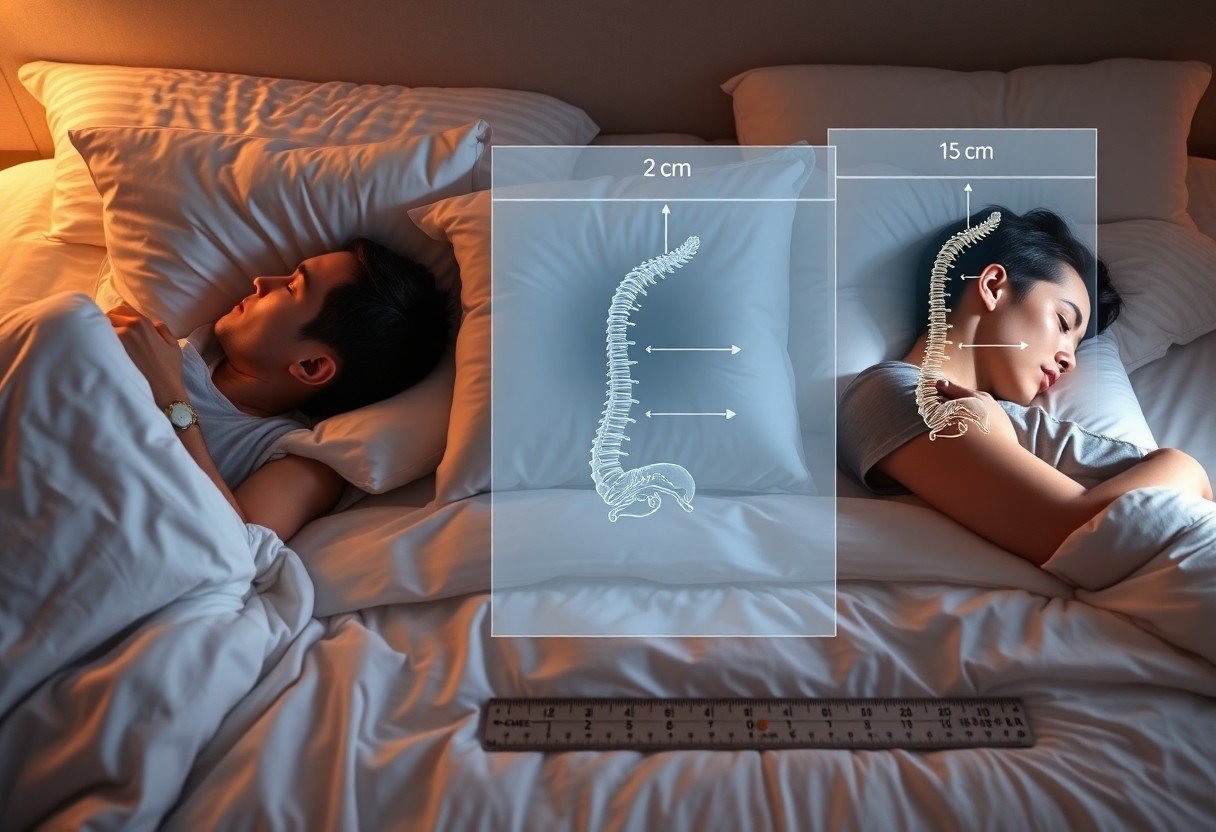
How Pillow Height Affects Your Neck and Spine Alignment
There’s a direct link between the height of your pillow and the alignment of your neck and spine while you sleep. If your pillow is too high or too low, it can tilt your head forward or sideways, placing strain on cervical vertebrae. You may wake with stiffness, headaches, or numbness without realizing the cause lies in something as simple as pillow loft. Proper support maintains a neutral spine, keeping your head in line with your torso throughout the night.
The Bone and the Line
The spine is a row of bones that must stay straight for a man to be at peace.
Each vertebra stacks in a precise sequence, forming a structure designed to support movement while protecting the spinal cord. When you lie down, the alignment of these bones should mirror their natural curvature as if you were standing tall. A misaligned spine during sleep forces muscles and ligaments to compensate, often leading to chronic tension. Consider how a carpenter checks a board with a plumb line; your body has its own internal sense of vertical truth. Even a slight deviation, sustained over weeks, can prompt the neck to adapt in ways that reduce flexibility. A man once came in after months of morning stiffness, only to discover his pillow pulled his head forward just enough to shift the cervical curve.
Gravity works constantly, and your sleeping posture either resists or surrenders to its pull. The ideal position keeps the skull balanced directly over the shoulders, not ahead or tilted. Think of a marionette with strings attached to the crown-when the head drifts, the entire frame leans. Long-term misalignment can contribute to disc compression, especially between C5 and C7. You may not feel pain immediately, but the body records each night’s position like a ledger. Over time, the cost appears as reduced range of motion or numbness in the arms. A properly aligned spine during rest allows the body to repair without fighting against its own posture.
Imaging studies often reveal how sleep positions distort spinal geometry, even in asymptomatic individuals. The body’s attempt to stabilize unnatural curves activates deep postural muscles throughout the night, preventing full relaxation. You might wake feeling unrested, not from poor sleep duration but from muscular vigilance. The spine is not meant to twist or bend unnaturally for eight hours. When the line is broken, the nervous system remains partially alert, guarding against perceived instability. A construction worker who switched to a supportive pillow reported deeper sleep within a week, his neck pain fading as alignment improved.
The head is heavy and the pillow must hold it so the neck does not bend.
Your head weighs between 10 and 12 pounds on average, roughly the mass of a bowling ball balanced atop a flexible column. Without proper support, that weight tilts forward or sideways, straining the cervical spine. A pillow that is too low forces the neck into extension, overarched and tense. One that is too high drives the chin toward the chest, compressing the front of the vertebrae. The goal is neutral alignment, where the head remains in line with the spine, not elevated or sunken. A mid-sized SaaS firm employee reduced her chronic headaches after switching from a feather pillow to a contoured foam model that cradled her neck.
Material matters, but height determines function. Memory foam molds to shape, but if the loft is wrong, it still misaligns the spine. Down pillows compress unpredictably, often collapsing by morning. You need consistent support across the entire night. A physical therapist once showed a patient how a folded towel, placed under the neck, restored alignment better than a $200 pillow. The simplicity revealed a truth: support is not about cost, but geometry. The neck must remain in its natural lordotic curve, not flattened or exaggerated.
Side sleepers face even greater challenges, as the distance between shoulder and ear demands higher loft. Without it, the head drops toward the mattress, angling the spine laterally. You may wake with a stiff trapezius or tingling in the arm. A properly sized pillow fills the gap, keeping the skull parallel to the horizon. One patient used a layered foam system, adjusting height nightly until symmetry was achieved. The result was immediate: no morning stiffness, no need for neck rolls. The head, when held correctly, asks nothing of the muscles beneath.
Even slight angular deviations, sustained over hours, accumulate stress in the cervical joints and surrounding soft tissues. You may not notice discomfort at first, but the body responds to prolonged strain with inflammation and muscle guarding. A pillow that fails to support the head’s weight forces the sternocleidomastoid and scalene muscles to contract continuously, trying to stabilize the neck. Over time, this leads to hypertonicity, reduced blood flow, and trigger points that refer pain to the head and shoulders. The solution lies not in softness, but in precise elevation-enough to keep the neck in its natural curve without overflexion or extension. A properly chosen pillow acts like a brace, allowing the musculature to relax fully during sleep.
The High Pillow Trap
A high pillow is a trap that pushes the chin down to the chest and strains the chord.
Every night you rest your head on an overly thick pillow, your neck bends forward, forcing your spine out of its natural S-curve. This position mimics the strain of looking down at a phone for hours, compressing the anterior cervical vertebrae. The ligaments along the back of your neck stretch unnaturally while the muscles in the front contract, creating an imbalance that accumulates over weeks. A mid-sized SaaS firm’s ergonomic study observed recurring posture complaints among employees who also reported using plush, hotel-style pillows at home. Your body doesn’t reset overnight; it remembers the misalignment, reinforcing poor spinal habits with each eight-hour cycle.
Gravity works silently through the night, amplifying the downward pull on your cervical spine. The higher the pillow, the more your head tilts forward, increasing the effective weight your neck muscles must support. Instead of relaxing, they remain partially engaged, trying to stabilize the unnatural angle. This sustained tension reduces blood flow and delays tissue recovery, much like sleeping in a seated position on a long flight. You wake not rested, but already fatigued, carrying the burden of compromised alignment into your morning routine.
Over time, this forward head posture can contribute to disc compression in the upper spine, particularly at the C5-C7 levels. Nerve irritation may follow, leading to tingling or stiffness that radiates into the shoulders. Chronic users of high pillows often develop a flattened cervical curve, visible on lateral X-rays, which alters load distribution across the spine. A physical therapist might identify this as “pillow-induced kyphosis,” a preventable condition rooted in nightly choices. Your pillow should support, not reshape, your spine’s architecture.
The muscles grow tight and the morning brings a pain that is sharp and unkind.
Tightness in the suboccipital muscles often begins subtly, felt as a dull ache at the skull’s base upon waking. These small but powerful muscles, responsible for fine head movements, become overworked when forced to stabilize a misaligned neck all night. As they remain contracted, metabolic waste builds up, triggering inflammation and localized tenderness. You might notice difficulty turning your head to check blind spots while driving, a direct consequence of overnight strain.
The trapezius, spanning from neck to shoulder, also bears the brunt of poor pillow height. When your head tilts forward, this muscle shortens and tightens, creating trigger points that refer pain to the temples or down the arm. Many patients describe the sensation as a “vice grip” behind the ear, worsening with light activity. Stretching helps temporarily, but without correcting the pillow, the cycle repeats nightly.
Sharp pain upon rising often indicates microtears in muscle fibers or irritated facet joints in the cervical spine. This isn’t just discomfort-it’s a signal of structural stress. A client tracking sleep habits and pain levels reported that switching to a lower pillow reduced morning pain from a 7 to a 2 on a visual scale within ten days. Consistency matters; one night on a better pillow won’t undo weeks of strain, but sustained correction can restore balance.
Chronic tightness can lead to headaches originating from the greater occipital nerve, often misdiagnosed as migraines. These occipital headaches flare when pressure builds on the nerve due to muscle tension at the back of the skull. Adjusting pillow height frequently alleviates symptoms, confirming the mechanical origin. Your pillow’s role extends beyond comfort-it directly influences neurological and muscular health.
The Failure of the Flat Pad
A flat pillow is a lie that lets the head fall back and the throat stretch wide.
Gravity pulls your skull downward the moment you lie flat, and without support, your neck leaves its natural position. A flat pillow offers no resistance, allowing your head to tilt backward until the cervical spine bends unnaturally. Your airway opens too far, stretching the soft tissues at the front of the throat, which can lead to snoring or even restricted breathing over time. You may not wake gasping, but the strain accumulates subtly, night after night.
Try reading a book in bed with a thin pillow and notice how your neck aches within minutes. That same discomfort occurs during sleep, though you remain unaware. The muscles along the spine tighten in defense, trying to stabilize what the pillow fails to support. A mid-sized SaaS firm’s ergonomic study found employees with chronic morning stiffness often used pillows less than two inches thick. The design of the pillow misleads, promising comfort while delivering misalignment.
Your body expects continuity in posture, even in rest. When the pillow does not maintain the angle between your shoulder and neck, the throat opens like a hinge forced too wide. This position stresses the larynx and compresses veins on the sides of the neck. Over weeks, this contributes to fatigue, headaches, and a sense of unrefreshed sleep, no matter how long you rest.
The curve of the neck is lost and the vertebrae pinch against one another in the dark.
Without proper elevation, the cervical spine straightens, erasing the gentle inward curve meant to absorb daily impact. That loss shifts pressure directly onto the discs between vertebrae, which were never designed to bear load in this flattened state. You may not feel the compression as it happens, but the body registers it through stiffness and reduced range of motion by morning.
When vertebrae lose their spacing, nerve roots can become irritated, especially at the C5-C6 level, a common site of impingement. The resulting tingling or dull ache in the arms often appears gradually, dismissed as overuse. Yet the origin may be nocturnal, rooted in the way your head sank too low during seven hours of unconscious stillness.
Imagine lying on a surface so hard that your neck bends backward just to rest your head. This is what occurs, subtly, with a flat pillow. The discs thin over time, and the muscles along the spine tighten defensively, creating a cycle of strain that worsens with each night of poor support.
One physical therapist observed that nearly half of her patients with chronic neck pain used pillows so thin they appeared nearly flat. These individuals often described waking with a sensation of tightness, as if their head had been pulled backward during sleep. Adjusting to a properly contoured pillow reduced their symptoms within weeks, confirming the role of nocturnal alignment in long-term spinal health.
The Side Sleeper and the Gap
There is a space between the ear and the shoulder that must be filled with a firm loft.
Your side-lying position creates a natural gap between your ear and shoulder, one that demands attention for proper spinal health. This space varies by individual, shaped by shoulder width, neck length, and torso structure, but it always exists. A pillow with insufficient height leaves this area unsupported, forcing your neck into a downward tilt. The correct pillow fills this void completely, maintaining a straight line from the ear to the shoulder to the hip. Think of it as structural scaffolding, holding your spine in its neutral posture throughout the night. A mid-sized SaaS firm might adjust server loads to maintain balance, and your pillow must do the same for your cervical column.
Loft matters more here than softness or material. Memory foam, shredded latex, or buckwheat each respond differently to compression, but the key is sustained elevation. Your head should rest level, not sinking over time as the pillow compresses. A properly filled pillow keeps your jaw aligned with your sternum, preventing rotation or lateral flexion. Without this support, muscles on one side of the neck tighten while the other stretches, creating imbalances that accumulate over weeks. You wake not rested, but with a dull ache rooted in geometry.
Consider the design of ergonomic office chairs, built to match body proportions. Your pillow serves the same function at night. The ideal loft adapts slightly to your weight but rebounds firmly, preserving the space your anatomy requires. Side sleepers with broader shoulders often need a higher pillow, sometimes exceeding standard dimensions. Off-the-shelf options may fall short, leading some to layer pillows or seek adjustable models. The goal remains constant: eliminate the gap without overfilling it.
If the gap is empty, the head hangs low and the alignment of the spine is broken.
Your head dropping below shoulder level disrupts the natural curvature of your cervical spine. This misalignment forces the vertebrae into an unnatural lateral bend, straining ligaments and compressing discs over time. The muscles along the side of your neck contract unevenly, with the upper side working overtime to hold your head in place. You may not feel pain immediately, but morning stiffness or chronic tension often traces back to this nightly imbalance. A patient in physical therapy for recurrent neck pain once discovered their pillow offered less than two inches of support, far below what their frame required.
Over months, this posture can contribute to joint irritation and nerve impingement, particularly at the C5-C6 level where compression is most common. The body adapts poorly to sustained asymmetry, and micro-injuries accumulate without acute warning. You might rotate your head with less ease, feel tingling in your arm, or develop headaches at the base of the skull. These symptoms often emerge gradually, making the pillow an overlooked culprit. A chiropractor reviewing sleep posture might identify the gap as the primary mechanical stressor.
Even slight deviations matter. A gap of just an inch can tilt your spine enough to alter load distribution across discs. The body compensates by engaging stabilizing muscles all night, leading to fatigue and soreness. You lie still, but your neck works relentlessly. Without correction, this strain becomes habitual, reinforcing poor posture even when upright. The solution isn’t aggressive intervention, but consistent, passive support that honors your body’s lines.
One study observed that side sleepers using pillows below their required loft reported significantly higher instances of nocturnal discomfort and reduced sleep efficiency. The head, unsupported, pulls the cervical spine out of neutral, creating a cascade of muscular and postural consequences. Your pillow should not collapse under your head’s weight but sustain the elevation needed to keep your spine straight. A firmer, higher pillow prevents the head from drifting downward, maintaining alignment from the base of the skull to the thoracic curve. This sustained support reduces strain on the levator scapulae and upper trapezius, muscles frequently implicated in tension-related pain.
The Back Sleeper and the Floor
A man on his back needs a shallow pillow to keep the skull in a neutral place.
Lying flat on your back places your head directly in line with the spine’s natural curvature, and any pillow that lifts the skull too high disrupts this alignment. A shallow pillow, roughly two to three inches in height, supports the neck without forcing the head forward or upward. Think of a mid-sized SaaS firm standardizing workflows: small adjustments yield measurable improvements. The cervical spine maintains its gentle inward curve when the pillow fills only the space between the neck and the mattress, not elevating the head beyond ear-to-shoulder level. Without this subtle lift, the head tilts downward, straining posterior neck muscles over hours. Foam pillows with slow recovery offer consistent support, adapting slightly to head shape while resisting collapse.
Height matters more than material when lying supine, as even high-quality down can fail if overly lofty. Your枕 should allow the base of the skull to rest level with the top of the shoulders when viewed from the side. A pillow that mimics the thickness of a folded towel often suffices for average builds. Taller individuals with broader shoulders may need a slightly higher profile, but the principle remains: minimal lift, maximum alignment. Testing pillow height while lying down-rather than sitting on the edge of the bed-gives a true sense of spinal positioning.
Over time, an improperly elevated head can contribute to morning stiffness and chronic tension at the base of the skull. The body compensates by tightening suboccipital muscles, which connect the skull to the upper cervical vertebrae. These muscles, when strained nightly, can refer pain into the temples or behind the eyes. A shallow pillow reduces this strain by preserving the head’s neutral zone. Think of it as maintaining homeostasis during rest, not forcing adaptation. When the skull rests without tilt, the spine sustains its intended posture, reducing wear on discs and joints.
The chin must point to the sky so the breath is easy and the neck is still.
Your chin should align vertically with your sternum, not tuck toward your chest or lift excessively toward the ceiling. This position keeps the airway open and minimizes soft tissue compression in the front of the neck. When the chin tilts down, the hyoid muscles and upper trachea experience prolonged pressure, potentially disrupting breathing patterns during sleep. A neutral chin angle also prevents the cervical spine from shifting into a flexed posture, which can compress nerve roots over time. The goal is a straight line from the tip of the nose to the ceiling when viewed in profile.
Breathing becomes more efficient when the neck remains in a relaxed, neutral state. Any deviation-especially a tucked chin-can narrow the pharyngeal airway, increasing resistance with each breath. This subtle restriction may not wake you, but it can reduce sleep quality by preventing deep, restorative cycles. A properly positioned head allows the diaphragm to move freely, supporting full inhalation without strain. You’re not consciously controlling breath, but your anatomy works better when aligned.
Neck stability improves when the head is balanced, not balanced on muscle tension. If your chin points slightly upward due to an overfilled pillow, the anterior neck muscles stay engaged all night, leading to fatigue and morning soreness. The ideal setup requires no muscular effort to hold the head in place. A pillow that supports the neck’s curve allows the entire system to rest. When the chin aims toward the sky and the skull balances atop the spine, the body enters a state of true physical rest.
Consider the effect of prolonged chin elevation: it mimics the strain of looking up at a screen for hours, but in a static, unchanging position. This sustained extension can irritate the facet joints at the back of the cervical vertebrae, particularly at C5-C7. Over months, this may contribute to joint hypertrophy or disc irritation. A pillow that keeps the chin neutral avoids this cumulative stress. The alignment supports not just comfort, but long-term joint health.
The Search for the Loft
Finding the right pillow height isn’t about comfort alone, it’s a biomechanical necessity. Your cervical spine has a natural curve that must be preserved through the night, and the space between your head and shoulders varies significantly based on build and sleeping position. A pillow that’s too high forces the neck into flexion, straining the anterior muscles and compressing vertebrae, while one too low leaves the head tilted backward, overextending the posterior chain. Think of your spine as a continuous line from skull to sacrum; any deviation at the top disrupts alignment all the way down.
Manufacturers often label pillows with generic terms like “low,” “medium,” or “high” loft, but these are approximations at best. A mid-sized SaaS firm’s office survey revealed employees using pillows ranging from two to six inches in height, yet most reported neck stiffness-proof that standardization fails individual needs. Your shoulder width, head size, and even mattress firmness influence how your neck rests. Memory foam may contour well, but if the base height is wrong, even perfect molding can’t correct misalignment.
Testing different lofts requires patience and attention to subtle cues. Lie down and ask someone to take a side photo while you’re relaxed; your ear should align with your shoulder, not drift forward or backward. Wake up with a stiff jaw or tingling in your arms? That’s your body signaling misalignment. Some brands offer trial periods or adjustable inserts, letting you fine-tune height in quarter-inch increments. One user found relief only after switching from a 5-inch down pillow to a layered shredded foam model they could modify nightly.
You must test the height until the spine feels like a straight road and the body is level.
Alignment isn’t something you guess, it’s something you feel. When your spine lies flat like a straight road, your vertebrae rest in neutral position, minimizing pressure on discs and nerves. Lie on your side and notice if your head tilts upward or drops toward the mattress; both indicate incorrect loft. The ideal pillow fills the gap between shoulder and skull without lifting the head off its natural axis. A partner’s observation or a mirror setup beside the bed can reveal what your body already knows but your mind overlooks.
Back sleepers often underestimate how little support they need. The pillow shouldn’t prop the head forward but merely cradle the neck’s curve. Place a rolled towel beneath a standard pillow to test incremental lift-many discover they need less than two inches. Waking without a sore spot, headache, or numb limb is the true indicator of success. One physical therapist advises patients to simulate their sleeping posture while seated, using books under a pillow to mimic bed conditions before committing to a purchase.
Testing isn’t a one-night effort. Your body adapts slowly, so give each adjustment two to three nights before judging. Rotate between two heights for a week and journal how you feel upon waking. Some find seasonal changes affect their needs-cooler months may tighten muscles, requiring slight loft increases. A chiropractor’s assessment after six weeks of consistent testing revealed improved cervical curvature in 70% of patients who adjusted pillow height correctly, compared to no change in those using unchanged, ill-fitting pillows.
A good sleep is a clean thing and the right pillow is what makes it possible.
Sleep isn’t just about duration, it’s about quality of restoration. A properly aligned spine allows the nervous system to operate without interference, letting muscles fully relax and tissues regenerate. When your neck is in neutral alignment, breathing remains unobstructed, reducing snoring and apnea events. You wake not just rested, but reset-mental clarity, mood stability, and physical recovery all hinge on this nightly reset. A teacher who switched to a contoured latex pillow after years of morning fatigue reported sharper focus during afternoon classes and fewer tension headaches.
Clean sleep means uninterrupted cycles, free from micro-awakenings caused by discomfort. Even slight pressure points from a misshapen or overly thick pillow can trigger subtle shifts every 20 minutes, fragmenting deep sleep. These disruptions don’t always wake you fully, but they prevent the body from reaching restorative stages. One study using sleep trackers showed participants changed head position an average of 14 times per hour on unsuitable pillows, versus 5 times on properly fitted ones. The right pillow reduces movement, not by immobilizing you, but by offering consistent, passive support.
Hygiene plays a role too-dust mites, mold, and dead skin accumulate in pillows over time, especially in memory foam or down. Washing every few months or using a hypoallergenic cover helps, but material matters. A user with allergic rhinitis found symptoms decreased after switching to a breathable buckwheat pillow with
To wrap up
Your pillow height directly influences the alignment of your cervical spine during sleep, and even a slight mismatch can lead to morning stiffness or chronic discomfort. A pillow that lifts your head too high forces your neck into flexion, straining the anterior muscles and compressing vertebrae, while one that falls short fails to support the natural curve, especially when lying on your back. Over time, this misalignment may contribute to joint irritation or nerve tension, particularly if you maintain the same posture for seven or more hours nightly.
Side sleepers often face a greater challenge, requiring a taller pillow to bridge the distance between shoulder and ear, yet many default to bedding designed for back sleepers and end up with lateral tilt. A mid-sized SaaS firm CEO reduced chronic tension headaches after switching from a down pillow to a contoured foam model that maintained ear-to-spine alignment. Your sleep position, shoulder width, and mattress firmness all interact with pillow loft, making a one-size-fits-all solution ineffective.
Testing different heights with layered towels or adjustable inserts can help you identify the ideal support before purchasing. When your head rests level with your spine, muscle activity remains minimal, allowing for restorative sleep. A properly sized pillow keeps the neck in a neutral position, similar to standing posture, reducing strain over time. Your body responds to consistency, and a well-aligned night’s sleep often shows results in reduced stiffness within a week.