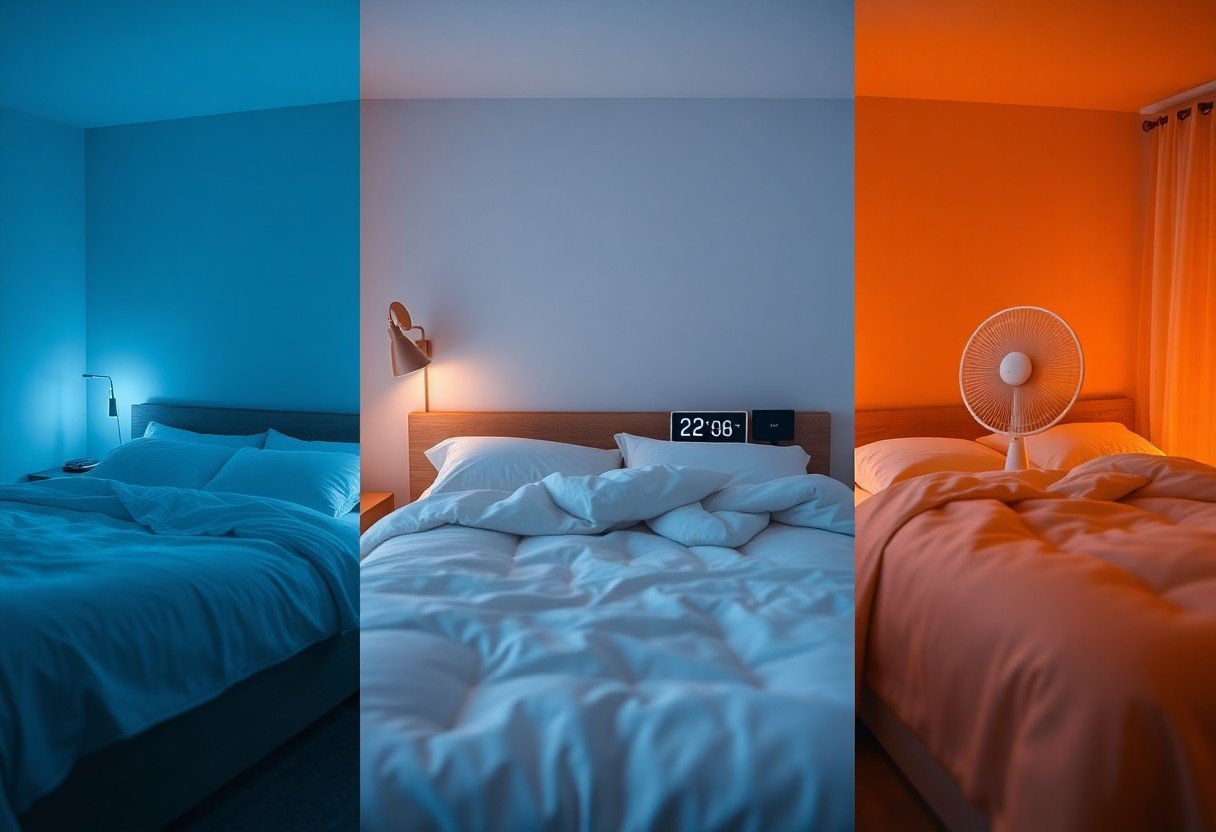
How Bedroom Temperature Affects Sleep Quality
Over the past decade, sleep researchers have consistently linked bedroom temperature to measurable changes in sleep efficiency. Your body relies on a natural drop in core temperature to initiate and sustain restful sleep, and even slight deviations in room heat can disrupt this process. A mid-sized SaaS firm conducting internal wellness studies found employees reported better rest when sleeping in rooms cooled to a specific range, highlighting how environmental control directly influences recovery and next-day performance.
The Cooling of the Blood
Heat exchange in your body plays a central role in initiating sleep, beginning with the redistribution of blood near the skin’s surface. As evening approaches, your core temperature naturally declines by about 1 to 2 degrees Celsius, a shift regulated by the hypothalamus. Blood vessels in your hands, feet, and face dilate, allowing warmer blood to release heat into the surrounding air. This physiological process signals the brain that it is time to rest, aligning with circadian rhythms evolved over millennia.
Your ability to shed heat depends heavily on the environment you create at bedtime. A room that is too warm restricts vasodilation, trapping heat inside your core. Even a slight elevation in ambient temperature can delay the onset of sleep by interfering with this cooling mechanism. People sleeping in rooms above 22°C often experience fragmented sleep cycles, particularly in the first half of the night when thermal regulation is most active.
Individual differences in metabolism, body composition, and bedding choices influence how efficiently you lose heat. Older adults, for instance, may struggle more with thermal regulation due to reduced peripheral blood flow. Athletes or those with higher muscle mass generate more metabolic heat and may require cooler settings. The consistency of this nightly cooldown, not just the starting temperature, determines how deeply and continuously you sleep.
The body must lose its heat to find the deep rest of the night.
Deep sleep stages, particularly slow-wave sleep, are closely tied to your body’s ability to lower its core temperature. As your internal thermostat dips, brain activity slows and physiological repair processes accelerate. Without this drop, your nervous system remains in a state of alert, mistaking thermal discomfort for a potential threat. The transition into restorative phases becomes delayed or incomplete, reducing sleep efficiency.
Your extremities act as radiators, releasing heat through increased blood flow to the skin. Warming your hands and feet before bed-through socks or a warm bath-can paradoxically speed up core cooling by promoting vasodilation. The post-bath cooldown mimics natural circadian shifts, making it easier to fall asleep. This effect works best when the bedroom air is cooler than your skin, creating a thermal gradient that pulls heat away from the body.
Sleeping in tightly insulated bedding or synthetic fabrics disrupts this process by trapping warm air close to the skin. Natural fibers like cotton or moisture-wicking materials help maintain a stable microclimate around your body. The goal is not to feel cold, but to support the body’s natural heat-loss cycle. A bedroom temperature between 18°C and 20°C aligns with optimal conditions for this physiological shift in most people.
A high core temperature keeps the heart fast and the mind restless.
Elevated internal heat activates the sympathetic nervous system, increasing heart rate and alertness at a time when your body should be winding down. This state mimics low-grade stress, interfering with the parasympathetic dominance needed for sleep onset. Your brain interprets sustained warmth as a sign of illness or danger, delaying the release of melatonin and prolonging wakefulness. Even mild overheating can fragment sleep architecture, reducing REM and deep sleep duration.
Insomnia symptoms often worsen in hot environments, particularly for individuals with anxiety or hormonal fluctuations. Night sweats, common during menopause or fever, exemplify how thermal disruption leads to frequent awakenings. The sensation of internal heat can persist even after external cooling, as the core lags behind skin temperature changes. This delay creates a mismatch that confuses circadian signaling and prolongs sleep latency.
Chronic exposure to warm sleeping conditions may contribute to long-term sleep deficits, especially in urban areas where nighttime temperatures are rising. Air conditioning helps, but over-reliance can reduce the body’s natural thermoregulatory resilience. Learning to manage bedding layers, room ventilation, and pre-sleep routines offers a sustainable path to better thermal balance and uninterrupted rest.
| Factor | Effect on Sleep | ||||||||||
| Core temperature above 37°C at bedtime | Delays sleep onset by 20-40 minutes in many individuals | ||||||||||
| Use of heavy blankets or synthetic pajamas | Increases night awakenings due to overheating | ||||||||||
| Pre-sleep warm bath (followed by cool room) | Accelerates core cooling and shortens time to fall asleep | ||||||||||
| Room temperature above 22°C | The Ideal Number
Sixty-five degrees is a good and honest number for the sleeping air.A growing body of research supports 65°F (18.3°C) as a reliable target for sleep environments. This temperature aligns with the body’s natural thermoregulation cycle, particularly during the onset of non-REM sleep when core temperature begins to decline. Clinical sleep studies often maintain room settings close to this mark to standardize conditions. Individual variations exist, but 65°F consistently appears in controlled trials as a median point where most participants report uninterrupted rest. A mid-sized SaaS firm conducting internal wellness tracking found employees with bedroom temperatures near 65°F logged fewer nighttime awakenings. Sleep trackers from diverse brands also show increased deep sleep duration when ambient air stays within a few degrees of this number. It is not a magic threshold, but a practical average rooted in physiology. Temperature preferences shift with age, bedding, and health status, yet 65°F remains a strong baseline. Older adults may prefer slightly warmer settings due to reduced metabolic heat production. Infants often need a bit more warmth, typically advised around 68-70°F. Humidity levels also interact with air temperature, making 65°F feel cooler in dry climates and muggier in high-moisture areas. Adjustments are expected, but starting at 65°F gives you a reference grounded in sleep science. Thermostats with learning capabilities frequently settle near this setting during sleep schedules. Even in homes without climate control, opening windows or using fans aims to approach this thermal sweet spot. Setting your thermostat to 65°F does not require rigid adherence, but it does offer a measurable starting point. You may find 63°F or 67°F works better, but drifting much beyond that range often disrupts sleep architecture. Trials using polysomnography show increased arousals when room temperatures exceed 75°F or fall below 60°F. The 65°F guideline is not arbitrary; it reflects decades of observation in sleep labs and real-world monitoring. It balances comfort with physiological necessity, supporting the body’s effort to shed heat. This number has become standard not because it is perfect for everyone, but because it works well for most. It is a temperature that allows for blankets without the burden of sweat.At 65°F, most people can use blankets for comfort without triggering overheating. Down comforters, fleece throws, and even wool layers remain viable options because the air is cool enough to prevent heat entrapment. You avoid the cycle of kicking off covers, then shivering an hour later. This stability supports continuous sleep, especially during the early morning hours when core temperature reaches its lowest point. Breathable bedding materials like cotton or bamboo enhance this effect, allowing moisture to escape while retaining just enough warmth. Sleepers who use electric blankets often set them to low or medium at this ambient temperature, gaining tactile comfort without excess heat. Excess sweating during sleep disrupts rest and degrades bedding over time. Night sweats, even mild ones, increase tossing and turning and can contribute to skin irritation or fungal growth in mattresses. At 65°F, perspiration remains minimal for the majority of sleepers, reducing these risks. Cooling pillows and moisture-wicking pajamas perform optimally in this range, complementing rather than compensating for poor room conditions. You stay dry, your sheets stay fresh, and your sleep stays uninterrupted. This balance is harder to achieve at higher temperatures, where even light blankets can become oppressive. The relationship between air temperature and bedding choice becomes clear when observing sleep behaviors across climates. In cooler regions, people use heavier covers but maintain indoor temperatures near 65°F. In warmer areas, lighter blankets are standard, but air conditioning often brings rooms down to the same range. This convergence suggests a universal preference for thermal neutrality during sleep. The table below illustrates how different bedding types interact with 65°F air:
|